Friday, September 26, 2014

Spotlight on the Apply Phase: the Anatomy of Mastery Learning Cycles

The Apply phase follows the flip phase in a mastery learning cycle. The purpose of apply is two fold: first, to practice the concepts learned in the flip phase and second, to revisit the exploration. 

Typically the students learn the content from a video. After they have taken notes, students complete a standards based problem set in the Apply phase. The questions of the problem set are organized by standard. 

At the beginning of each section, the standard is quoted and the questions specifically aligned to that standard follow. I denote mandatory questions in blue highlighting. Once students complete the mandatory problems, they are free to answer or not answer the other problems. Not all students require the same amount of practice for each standard. In addition, this builds in extra practice for those who choose not to complete the entire problem set the first time around. The mandatory questions usually point out special scenarios that students may encounter. For example, on the chi square inheritance problem set, one of the mandatory questions demonstrated what would happen if expected numbers were zero. Since the chi square formula has the expected number in a denominator of a fraction, any problem with expected as zero would be undefined; it's important to have this scenario as a mandatory problem because many students are tempted to incorrectly give this answer as zero. 

Answer keys are provided for all of the problem sets.  


I only show the answers and perhaps some of the work done. I've found when I show how the work is done, students are likely to copy the work, rather than trying to solve the problems. By giving them the answer key, they get immediate feedback and don't have to wait for me to be available to look over their work. However, they are less able to cheat since they must show their work on mandatory problems. 

The other half of the apply phase is the re-visitation of the explore phase. In the explore phase, students are introduced to a concept before direct instruction during the flip stage. Once students have practiced applying the concepts in the problem set, they are usually ready to tackle the explore re-visitation. 

Other activities that may take place during the apply phase are labs, discussions and case studies. These activities may also occur during the explore or apply phase, it just depends on whether it makes more since for the activity to teach a concept or apply a concept. Many times, these activities are divided into two parts - part A as an exploration and part B as the re-visitation during the apply phase. For example, in the explore phase of the Natural Selection learning cycle, the Part A of the Chips are Down lab asked students to collect data and draw conclusions about evolving populations. After learning more in subsequent activities, Part B in the apply phase required students to revise their conclusions. 

Once students have worked through the apply phase, they must sit with me to gain permission to enter the mastery phase which consist of a mandatory quiz and optional projects. 

Tuesday, September 16, 2014

The Magic of Google Forms for Beginners

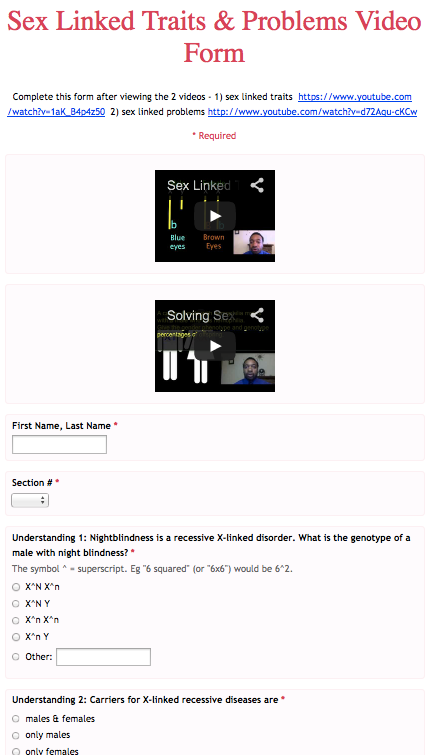
Google Forms can greatly enhance a course. The ease of use coupled with the spreadsheet that automatically organizes the responses, make Google Forms my go-to survey-maker. Below you'll find some great uses of Google Forms that are relatively easy to use and set-up.

1) Formative assessment - after watching the video, students complete the Google Form. Some of the form tasks might be answering questions, writing a summary and asking a question. The responses get organized in a spreadsheet and there is an option to view the responses in graphs. In a traditional class, this is analogous to an exit slip. I appreciate being able to gauge what my students know and are confused about before arriving to class. This information can inform my planning and intervention.


2) Student feedback - at the end of the year, I have students complete an anonymous course evaluation. I highly recommend doing it anonymously to help get genuine answers but some might disagree. I've learned some interesting facts about my course by reading through the responses. 


3) Student reflection - I use Google forms to reinforce meta cognition skills. Regularly, I have students complete a form as a means to reflect on their learning. They may also reflect on their contribution to a group project, which helps me formulate future groups or intervene.


4) Submitting work or lab data - if you have students create online materials, like blogs, presentations or videos, it can be daunting to organize these submissions. You can send a Google form requesting the URL of their assignment. In science classes, you can also have students share their data with the class by filling out a Google Form. When it's time to review student work, all of the links or data are organized in a spreadsheet for you. 

5) Polls - whenever I need to poll students, perhaps as a pre and post discussion activity about a controversial issue, I prefer to use Google forms as well. 


Google Forms can do a lot more, especially when scripts or add-ons enhance the response spreadsheets. For more uses of Google Forms, visit this site

Friday, August 29, 2014

Spotlight on the Flip: the Anatomy of Mastery Learning Cycles

In the flip stage, I cover the bulk of the content. I try to use just one video to cover the facts but may rely on two if I need to go beyond 10 minutes or teach two distinctly different concepts.

Prior to the flip, students have completed an exploratory activity, which created cognitive dissonance and challenged the students with a higher order thinking task. Typically, the students don't have the content to complete the task at that point; therefore, they need the video to provide the facts and background.

The video is not the only part of the flip stage. Students are provided with a guided note sheet that they have to fill out while viewing the video. 
Guided Note Sheet

In the latest videos, I've been more thoughtful of sound pedagogy. Those videos start with a warm up question to get students thinking about the concept. Throughout the videos, I intersperse questions, ask students to pause and record their answers on the guided note sheet. At the end of the video, they have to think of a question that they want answered or could be answered by the video. I'll have to work on getting students to ask higher order questions rather than the normal factual recall questions they tend to ask. 

After taking notes, students complete an online low stakes quiz. Quizzes from previous years were Google forms loaded with back-end scripts (like Flubaroo) to grade student responses and allow me to respond to student questions. Since we moved to a new learning management system (LMS), I've offloaded most of those tasks to Haiku. The quizzes, called practice assessments on Haiku, consist of understanding level questions to give students feedback about whether they need to re-watch the video. 
Beginning of Practice Assessment
I also include an online forum for students to ask and answer questions about the content in the video; the hope is that students will begin to get their questions answered by peers rather than me. Finally, students are asked to rate the video in order to help me prioritize which and what ways to edit the videos in the future. 
Video Feedback Form
While many folks are invariably interested in the Flip, I must remind you that the Flip is just a vehicle to making more important changes possible. The videos allow for differentiation, mastery, asynchronous learning, etc. When content is offloaded away from the community space, the real magic happens!

Wednesday, August 20, 2014

Spotlight on Mastery Choices: the Anatomy of Mastery Learning Cycles

In this spotlight, we'll explore the mastery assignments of the mastery phase. In each learning cycle, students will have the opportunity to extend their thinking on specific standards beyond the application level in Bloom's taxonomy. They'll also be able to choose the nature of the assignment and even within the options, there is room for differentiating the level of difficulty. Depending on the learning cycle, these mastery assignments may be organized into choice boards, 2:5:8 boards, tic tac toe boards, think dots or cubing boards. I'll explain some of the options below.

Choice Boards
In some learning cycles, I use choice boards. Choice boards typically have nine project choices, of which students select one. Each choice will encompass all of the relevant learning standards; therefore, only one project is needed. The Analysis, Evaluation and Creation levels of Bloom's taxonomy are equally represented. In addition, different learning preferences are represented - students have the option in the type of modality: video, article, essay, cartoon, poem, etc.


2:5:8 Board
The 2:5:8 board gives students options between levels of difficulty. The rule is the students have to complete assignments that add to ten; for example, a student may select one "2" level and one "8" level or two "5" level assignments. I also added a "10" level assignment, where students could opt for just one assignment at a higher level of difficulty. I used Bloom's taxonomy again to determine which activities are level 2, 5, 8 and 10.


Think Dots
I use Think Dots similarly to choice boards. In both case, students only select one option. The major difference is theoretically, students don't actually choose the assignment. Students roll die to determine which project to complete. Think Dots can work well if there aren't significant differences between rolling a "one" or a "three." In either case, students are basically completing the same assignment but the details are different. Other teachers use Think Dots differently but I like using it this way to encourage students to be okay with rolling the die and doing whatever assignment is randomly selected. There's a neat online die that one can use if physical dice are unavailable.


Tic Tac Toe
The Tic Tac Toe board is an effective variant of the choice board. Again, the assignments are aligned to specific standards as well as levels of Bloom's taxonomy. The way I use tic tac toe boards is when I have a variety of standards that are too difficult to encapsulate into one project. In this case, I still have nine project options, of which students have to select three. I can set up specific rules to force students to select specific types of projects. For example, in the board below, students have to go from top to bottom, either in the same column or at a diagonal. In that case, students are forced to select one project from each of the three rows. Each row has three options aligned to the same standards. The result is students cover all of the standards but have some choice in the combination of assignments.


My hope by using these strategies is students will complete higher order assignments to demonstrate mastery of specific standards. I'll be sure to reflect on the effectiveness of these tools at a later date.

Tuesday, August 12, 2014

Spotlight on the Mastery Phase - the Anatomy of Mastery Learning Cycles

Flickr // Powazny
 Based on recent questions via twitter after FlipCon14 regarding specifics of Mastery Learning Cycles (MLC), I've decided to write periodic blog posts about the inner workings of this model. This series, the Anatomy of MLC, will spotlight aspects of the model. In this first post, we'll explore the mastery phase.

Recall MLC consists of Explore, Flip, Apply and Mastery phases. More information about the other phases can be found in the initial blog post about MLC or future posts in this series. The Mastery phase is the culminating component of a learning cycle and consists of the following:


  1. Mandatory "hot seat" Discussion - a one-on-one or small group discussion where students are orally "quizzed" to determine whether they are ready to take the unit quizzes.
  2. Mandatory Standards-based Quizzes - randomized Moodle quizzes aligned to specific standards and application level of Bloom's taxonomy. Students can choose to, or be required to, retake the quizzes until they demonstrate proficiency of each standard. Students who fail will be required to complete a metacognition form for each quiz outlining their errors, as well as making corrections. Students can return to earlier phases and/or complete remediation activities before retaking a quiz.
  3. Optional Standards-based Mastery Assignments - higher order thinking assignments which are aligned to Bloom's taxonomy levels of Analysis, Evaluation and Creation. These projects will push the thinking of students and are based on specific standards. Completing the projects will move a student from application (3/4) to mastery (4/4) level.
The implications of this set-up is students can pick and choose which standards they want to demonstrate application or mastery understanding. The thinking here is students are required to be able to apply their learning of all standards but should be able to decide which standards they want to extend their thinking. Some students will be more interested in some standards; some students will find some standards more difficult. An added benefit of this approach in an asynchronous course is having optional assignments gives students an opportunity to catch up to the pace of other students, without loosing core content.

Friday, August 8, 2014

My Plunge into Standards Based Grading

Cody Hough // Wikipedia

After short-lived flirtations, I'm plunging into the Standards Based Grading (SBG) pool. Of all the recent changes to my course, SBG requires the biggest paradigm shift. Like many other updates to my biology course, my entry point was the flipped class - another testament to the benefits of flipped instruction.

What is SBG?
For those who are unfamiliar with standards based grading, this video should offer a good summary contrasting it with the traditional model of Assessment-Based Grading.


How am I approaching SBG in year one?
First, I've identified the standards. For each unit, I listed each learning objective and rephrased them as "I can" statements. (Thanks to @mrsebiology for the inspiration.) I've redesigned each unit as mastery learning cycles centered around these standards. I plan to acknowledge four levels of progress for each standard - does not meet (no evidence), approaching (explaining), meeting (applying) and exceeding (mastery.) 

First draft sample of a few genetics objectives
Second, I've tailored the learning materials (videos, readings, labs, etc) to the standards. This was an eye opening process because several materials that I've used in the past did not meet a specific standard; I was forced to delete these materials. The other important revelation was that some activities required too much effort in return for how they aligned with the standards. For example, if I identified a lab that took several days to complete but barely addressed one standard, I either modified it or chose an alternative. I forced myself to prioritize the "need to know" content and skills over the "nice to know" material. 

Third, I strategically designed assessments to align to the standards. Every quiz, lab or test question will be intentionally designed or modified to address the standards. Again, very eye opening process. I'm especially excited about this change because I will be able to generate informative data about each student. No longer will a student or parent see a vague "88%" on a report. The 88% could hide that this student struggled mightily on one topic, while excelling at the other topics. Instead of quoting numbers, I will be able to state the exact nature of the areas of strengths and weaknesses.  

I have a lot to learn and so glad that I have a wonderful group of teachers in my PLN.

So far I've found been using the following SBG resources:
I would love it if you can reply with your own list of Standards Based Grading resources.

Monday, July 21, 2014

Changing the Rules of Playing School


Eddie-grrl // Deviant Art

The game of school...how does one play school and more importantly, win? 

Let's start with some of the obvious. 
  • Turn in all assignments by their deadlines. 
  • Be able to regurgitate what your teacher said in class during exams. 
  • You get one attempt to show what you know on exams, so pay close attention to the calendar.
  • When you're absent, reach out to classmates and your teacher about missed assignments and notes. 
  • By the way, don't be late to class and try not to be absent because the work doubles when you miss class. 
  • Don't misbehave or talk to others when the teacher is talking at the front of the room. 
  • Some highly observant students would add to smile in class and pretend to be engaged in class no matter how boring the lesson or discussion. 

What happens when teachers attempt to change some of these rules? What if students no longer had to regurgitate on exams? What if students could take notes from a video on any day, even if they were absent? What if students designed their own artifacts with their own directions to demonstrate learning or could choose from a menu of assessments and projects? What if students had some say about when to submit assignments? 

Many flipped teachers are asking these very questions while changing some of the unwritten rules of school. Some teachers are met with resistance from students, parents, colleagues or administrators. It's understandable where this resistance originates. Imagine you, or your child, has been successful in school for 10 years operating under the same set of rules, now one of the teachers threatens this success by flipping the rules and responsibilities. It's hard to ask people to change habits, so it's no surprise some students resist taking more responsibility for their learning in exchange for more freedom. It's scary, just as the change is for the teachers. 

Flipped teachers can mediate some, not all, of this resistance. We can articulate the benefits of and our rationale for changing these rules. We happen to teach at the time of Common Core and Next Generation Standards, which require students to engage in higher order thinking and take on more responsibility. We have to explicitly teach the new skills we want from our students. We need to be organized and plan for anticipated obstacles. We have to share our success stories and recruit other teachers to join us. We have to be honest about the limitations of flipped learning, as well as our mistakes in implementation. Of upmost importance, we have to be patient with our students, and ourselves. Real change is a process requiring time and growth. What an exciting time to be a student and a teacher!